
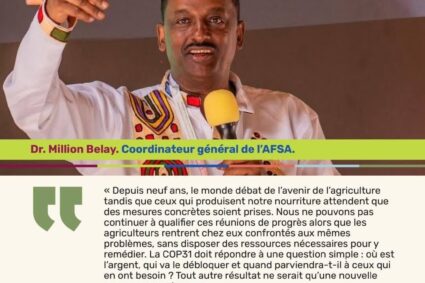


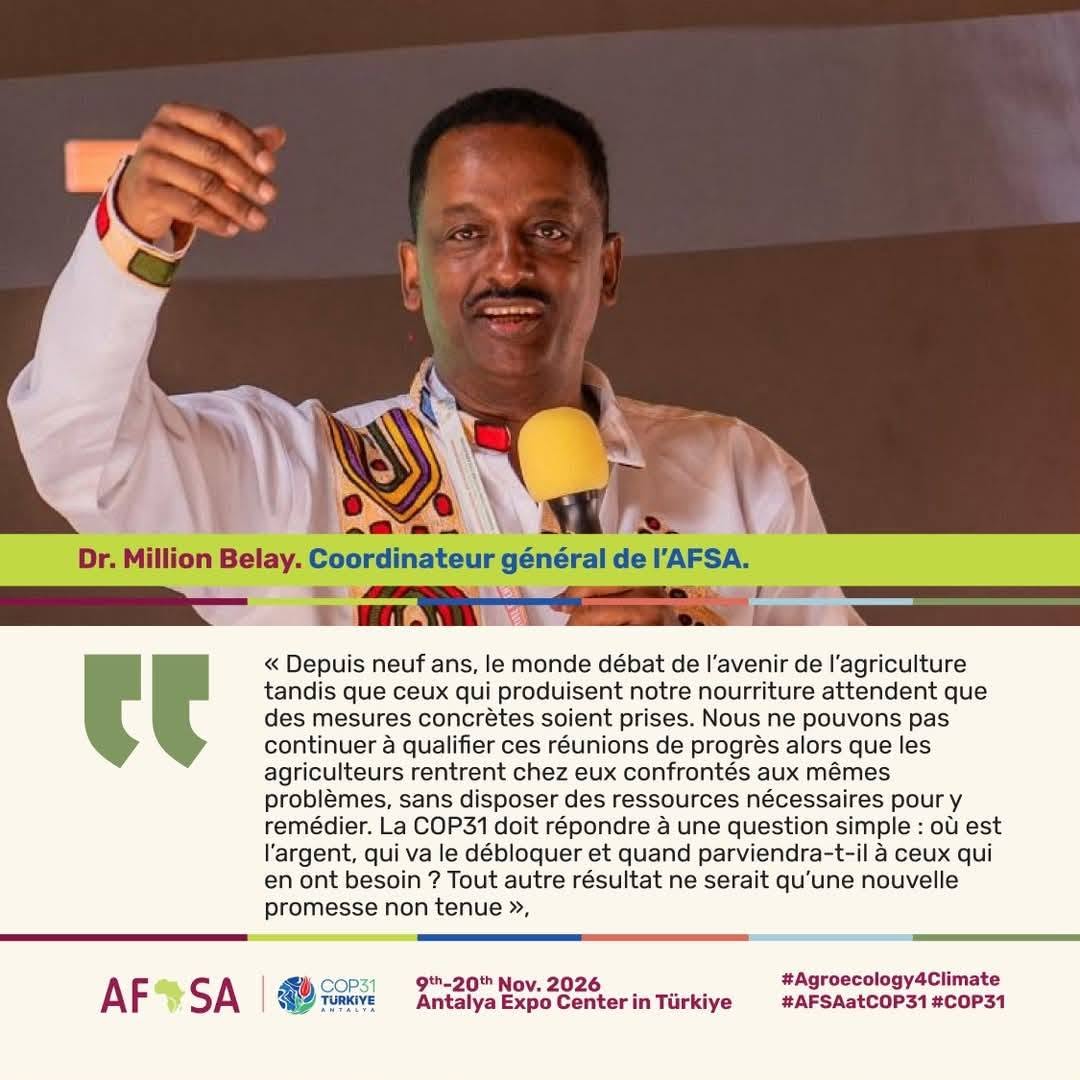
At COP31, taking place from 9 to 20 November 2026 in Antalya, Türkiye, the Alliance for Food Sovereignty in Africa (AFSA) is making the voices of African farmers heard.At the heart of its advocacy is the urgent need to move from commitments to concrete action by ensuring that climate finance is accessible to producers and farming communities directly affected by climate change.Present at the Antalya Expo Center, where COP31 proceedings are taking place, AFSA intends to use this international gathering as a platform to defend the interests of Africa’s smallholder and family farming communities. Its message is unequivocal: farmers are no longer waiting for new promises, but for concrete decisions, actual funding and mechanisms capable of addressing their needs on the ground.For Dr. Million Belay, AFSA’s General Coordinator, the time has come to turn the commitments made throughout the climate negotiations into tangible results.“After nine years of negotiations, farmers are waiting for concrete action, not another broken promise,” he stresses.Through this strong appeal, the AFSA coordinator raises a fundamental question at the heart of discussions on climate justice and adaptation finance: where is the money actually intended to support farmers? Who is responsible for releasing it and, above all, how long will it take to reach the communities that need it most?For the African organisation, the challenge goes beyond simply recognising the role of agriculture in tackling climate change. It also concerns farmers’ ability to access the financial resources needed to develop solutions suited to their local realities: soil restoration, agroecology, sustainable water management, biodiversity conservation, crop diversification and stronger resilience for family farms.This demand is also echoed by Karen Nekessa, Chair of AFSA’s Working Group on Climate and Agroecology. Her assessment is clear: “Recognition without funding changes very little.”Her statement highlights the persistent gap between international rhetoric about the role of farmers in climate action and the resources actually mobilised to support their initiatives.For African farmers, being recognised as essential actors in the climate transition must translate into equitable access to funding, technical resources and appropriate support mechanisms.An advocacy agenda to put farmers at the heart of decision-makingIn Antalya, AFSA is championing a vision of agricultural and climate transition based on the effective participation of farmers in decision-making processes.The organisation is calling for an agricultural framework that places farmers at the centre of climate policies, provides financial support for their own solutions and requires governments to genuinely account for the commitments they make.Beyond the negotiations, this advocacy highlights an essential reality: African farmers are not merely potential beneficiaries of climate finance.They are also frontline actors, custodians of knowledge, drivers of innovation and indispensable partners in building sustainable and resilient food systems.AFSA’s participation in COP31 therefore takes on particular significance. It helps bring the concerns of African farming communities into international negotiating spaces, where their voices are often underrepresented, despite the fact that they face droughts, land degradation, increasingly erratic rainfall and multiple vulnerabilities associated with climate change.In Antalya, AFSA is not simply asking for a seat at the negotiating table.It is demanding that farmers’ voices lead to decisions, that financial commitments become accessible resources and that producer-led solutions finally receive support commensurate with the scale of the challenges.For African farmers, climate justice cannot remain a mere declaration of intent. It must be measured by the funding actually mobilised, how accessible it is and whether it reaches the women and men who sustain local communities, keep rural territories alive and feed populations.Babaclimat – Journal Agropasteu