


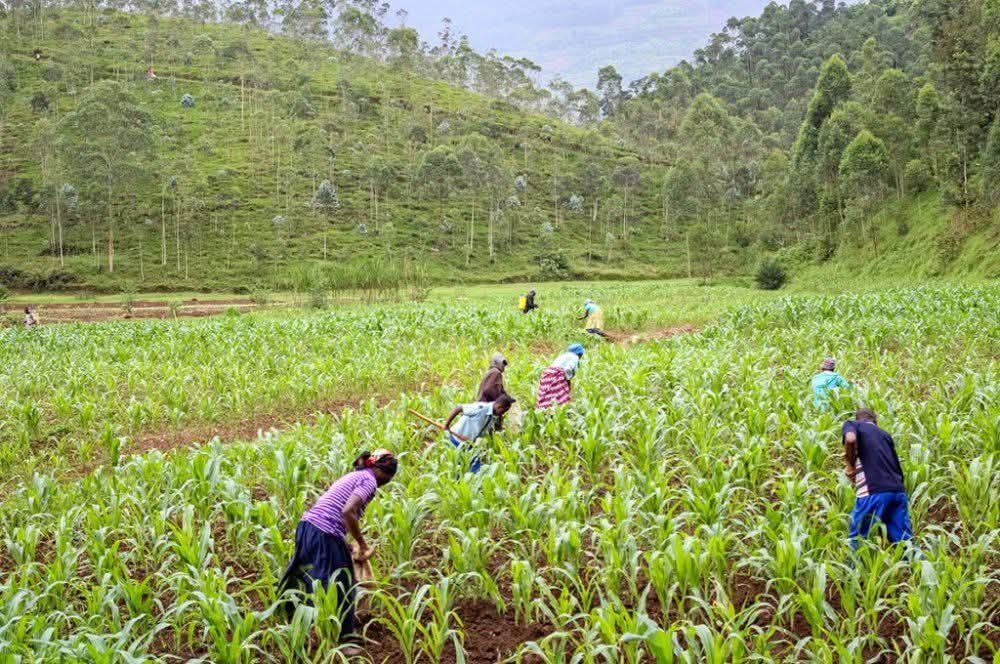
Rwanda continues to stand out as a reference in agricultural governance and food security. True to the vision of President Paul Kagame—focused on expanding cultivated areas and intensifying farming practices—the country reached in 2024 an impressive rate of 58% of its total land dedicated to agriculture and livestock, according to the latest report from the National Institute of Statistics of Rwanda (NISR).
The results of the Seasonal Agriculture Survey (SAS) reveal a positive trend, with remarkable progress in rice cultivation. During Season A, rice was grown on 17,173 hectares, up 6% compared to 2023, for a production of 69,098 tons (+8%). Season B confirmed this growth, reaching 72,834 tons, an increase of 4%. The average yield rose to 4.1 tons per hectare, thanks to irrigation and the use of quality seeds.
In addition, nearly one million hectares were devoted to short-cycle crops (maize, beans, sorghum), while 513,000 hectares were used for perennial crops such as bananas, coffee, and tea, and 116,000 hectares were allocated to livestock.
However, the report highlights a significant decline in potato cultivation areas. In Season A, they decreased by 3% (54,048 ha), and by 13% in Season B (41,836 ha). Production logically fell, dropping to 285,596 tons, before decreasing further in Season C with 80,929 tons harvested (-4%). Despite these declines, yields remain strong at 9.1 tons per hectare.
The NISR recommends stepping up efforts to support this strategic sector, particularly potato production, which is highly valued by Rwandan households.
With rigorous governance and an agricultural policy centered on water management, irrigation, and quality inputs, Rwanda stands as an inspiring model for many African countries seeking food security and sustainable development.
Babacar Sene, Agropasteur/Babaclimat Journal Agropasteur