




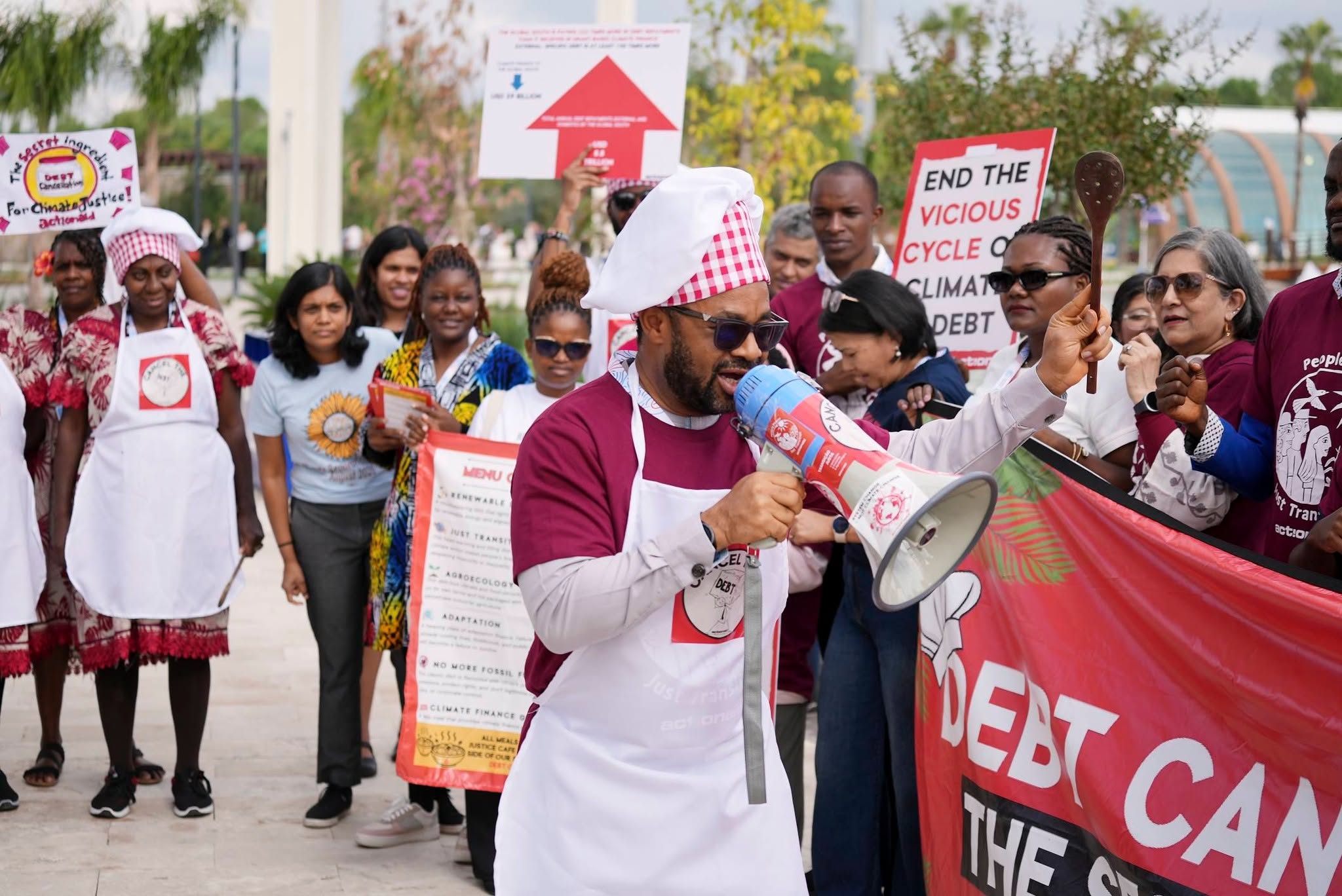
At COP31 in Antalya, ActionAid and its climate justice allies brought a special item to the menu: “Climate Justice”. Through this symbolic initiative in the Blue Zone, they delivered a powerful message: debt cancellation is a key ingredient for climate justice.For countries such as Senegal, climate justice means ensuring that the resources needed to address the climate crisis do not come at the cost of additional debt.From renewable energy and agroecology to climate adaptation and a just transition, countries need adequate financial resources to implement solutions that put people and the planet first.Yet debt repayments continue to drain public resources, limiting governments’ ability to invest in climate action and protect communities on the frontlines of the climate crisis.It is against this backdrop that ActionAid and its allies are mobilising within the Blue Zone through the symbolic “Climate Justice Menu” campaign, calling for concrete commitments and fair financing for countries in the Global South. Their demands include increased support for climate adaptation, a phase-out of fossil fuels and the promotion of community-centred agroecology, particularly for vulnerable communities.A symbolic action with significant political and media impactAn initiative such as the “Climate Justice Menu”, organised in the Blue Zone – the official space for COP negotiations managed by the United Nations – carries primarily political, media and strategic significance.First, it creates direct pressure on decision-makers. The Blue Zone is where negotiators, ministers and heads of state meet and conduct negotiations.It also provides visibility at the very heart of decision-making. Unlike street demonstrations, which often take place outside the official conference area or in the public Green Zone, taking action in the Blue Zone makes it possible to address decision-makers directly as they negotiate and draft agreements.The initiative also serves as a moral wake-up call. By using the accessible and striking format of a “menu”, it simplifies complex technical demands – including climate finance, loss and damage funding and a just transition – making them more visible and difficult to ignore within official negotiating spaces.Another important dimension is its media impact. Strong images and creative visual actions attract the attention of international journalists accredited to COP, who are often looking for ways to illustrate the tensions and challenges surrounding negotiations beyond official statements.The campaign hashtag also plays a role in digital mobilisation. Its use helps relay the initiative in real time to citizens around the world, generating public pressure that can reach national governments.Strengthening alliances across the Global SouthThe initiative also illustrates the strengthening of alliances across the Global South through a united front. By bringing together ActionAid and several partner organisations, it demonstrates the coordination of civil society actors, including NGOs, farmers, young people and Indigenous communities.It also provides support to vulnerable country delegations. Such actions can reinforce the position of developing countries, particularly African nations, whose negotiators are calling for fair climate finance in discussions involving countries with greater historical responsibility for greenhouse gas emissions.An initiative with limitationsNevertheless, this type of action has its limitations.First, it has no legally binding force. Campaigns of this nature do not have legal status and cannot guarantee that their demands will be incorporated into the final COP decisions.There are also strict access and organisational rules governing activities in the Blue Zone. Activists must obtain the necessary authorisations and comply with specific protocols, which can sometimes limit the scope and radical nature of their messages.In short, although such an initiative cannot, on its own, change international laws or climate agreements, it can help influence the balance of power, keep the climate emergency high on the media agenda and prevent negotiators from overlooking issues of social and financial justice.The “Climate Justice Menu” is therefore another innovative approach to advocacy and climate justice promoted by ActionAid. It echoes other major initiatives well known in our own context, such as “Kankokele” and “Activista”, which have contributed to positive changes in development pathways.Babaclimat / Journal Agropasteur