

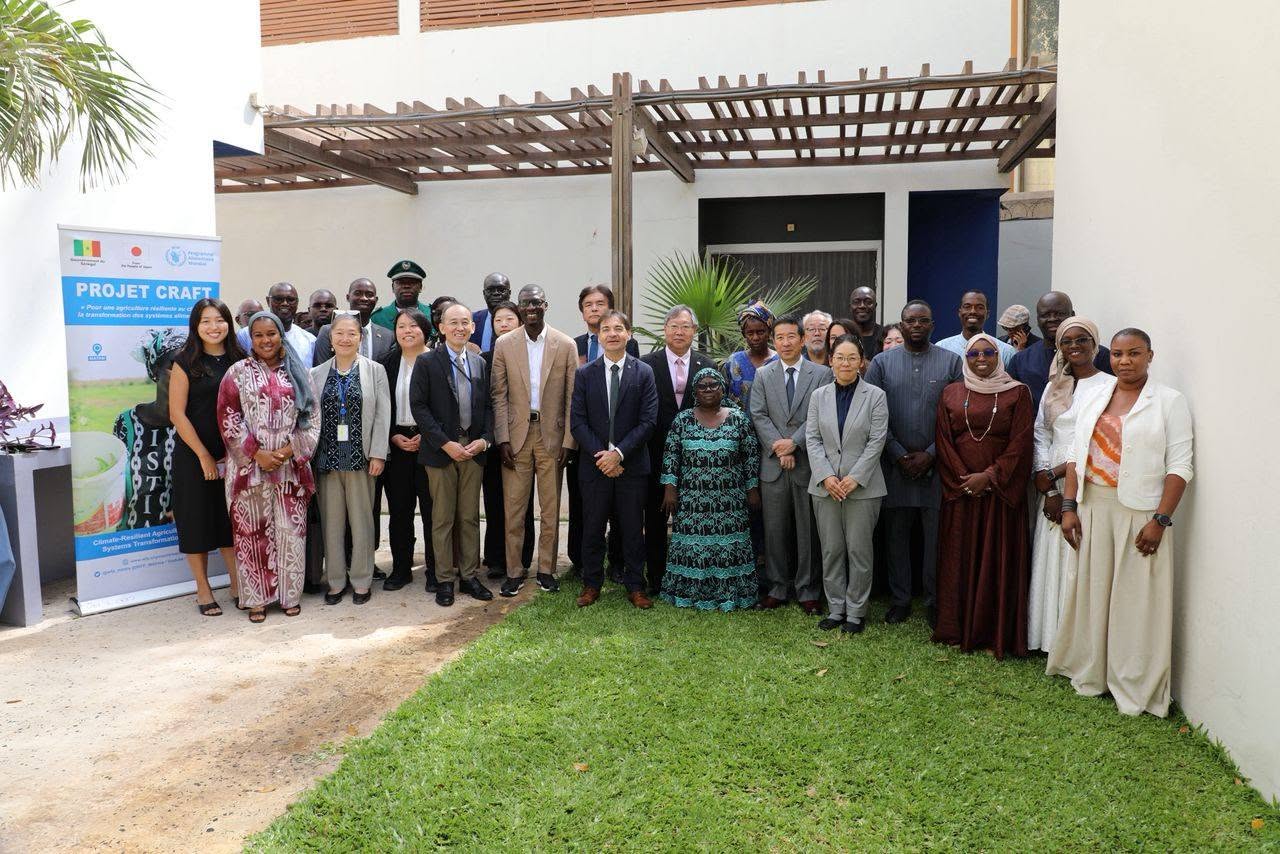
The United Nations World Food Programme (WFP), in partnership with the Government of Japan and Senegal’s Ministry of Agriculture, Food Sovereignty and Livestock (MASAE), officially launched the Climate-Resilient Agriculture and Food Systems Transformation (CRAFT) project.The initiative aims to strengthen the resilience of agricultural and food systems to the impacts of climate change while promoting sustainable food systems in Senegal.The project is jointly financed by the Government of Japan and WFP, which is also coordinating its implementation. It is one of the concrete outcomes of TICAD 9 and further strengthens more than twenty-five years of cooperation between Japan, Senegal and WFP in support of agricultural development and food security.Through CRAFT, the partners seek to support the implementation of climate-resilient agricultural policies, promote innovation, develop climate-smart farming practices and encourage greater private sector involvement, particularly from Japanese companies.The Matam region has been selected as the pilot area. Five intervention sites will gradually be established, benefiting approximately 1,200 people.The planned activities include vegetable production, horticulture, dissemination of climate-resilient agricultural practices, restoration of degraded farmland and capacity building for farmers.Senegal will thus serve as a regional laboratory for testing innovative approaches that could later be replicated across other African countries.Stronger Japan–WFP CooperationAccording to Mr. Pierre Lucas, WFP Country Director and Representative in Senegal, the project will be implemented in five agricultural sites across the Matam region.The first component, led by Japan’s Ministry of Agriculture, Forestry and Fisheries (MAFF), will support one pilot site over a three-year period, directly benefiting 200 smallholder farmers.The second component, financed by Japan’s Ministry of Foreign Affairs (MOFA), will support four additional sites, reaching nearly 1,000 beneficiaries.These interventions will draw upon the expertise of six Japanese companies specializing in innovative technologies such as water-retention polymers, Synecoculture and solar-powered irrigation systems.Beyond the figures, the project pursues several major objectives:Strengthening the livelihoods of rural communities facing climate shocks;Promoting private-sector innovation and sustainable agricultural investment;Facilitating dialogue among governments, development partners and private companies;Positioning Senegal as a demonstration hub for integrated Japanese-supported agricultural solutions in West Africa.Japan Reaffirms Its CommitmentSpeaking at the ceremony, Mr. Yashiaki Hatta, Chargé d’Affaires of the Embassy of Japan in Senegal, recalled that the partnership between Japan and WFP has lasted for more than twenty-five years.He stressed that Japan wishes to place its expertise and experience at the service of African countries facing the growing challenges of climate change, particularly in the agricultural sector.Representing the Minister of Agriculture, Food Sovereignty and Livestock on behalf of the Director General of SODAGRI, Mr. Oumar Ly praised the initiative, emphasizing that it directly contributes to the development of sustainable food systems and fully aligns with Senegal’s agricultural policy priorities.He highlighted that the partnership between Senegal, Japan and WFP represents a powerful lever for sustainably improving rural livelihoods through an approach based on co-creation, community participation, knowledge sharing and local ownership.According to him, this pilot phase offers a unique opportunity to position Senegal as a regional hub for climate-resilient agricultural innovation.He also stressed the importance of strengthening cooperation among African countries, promoting research, innovation and experience-sharing in order to accelerate the sustainable transformation of food systems.Finally, he called for enhanced South-South cooperation, noting that many effective solutions already exist across the African continent and now need to be scaled up.Mrs. Fatoumata Diallo, President of the Pélita Rewbé Women’s Economic Interest Group (GIE) in Bélitiowi, Matam Region, expressed her great satisfaction following the launch of the project.Her women’s group manages a vegetable production site that once served as their main source of income and food. Today, however, the site has become severely degraded, making vegetable and food crop production nearly impossible.Babacar sene journal Agropasteur