

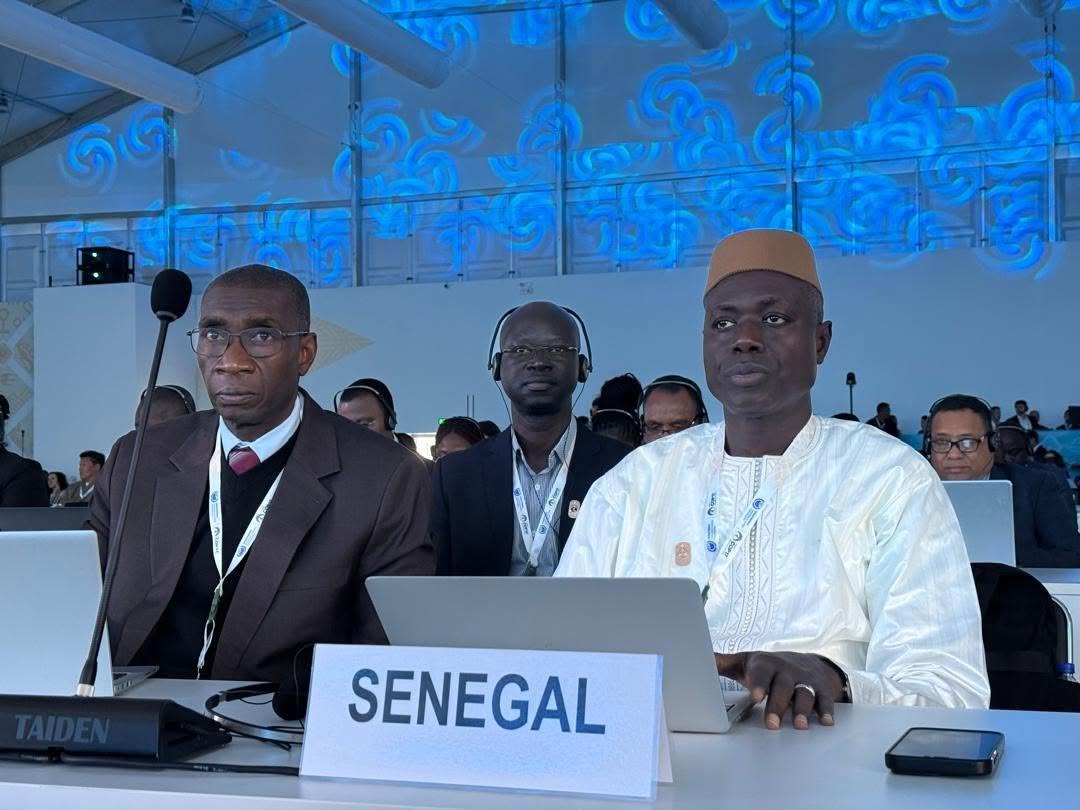
The 17th session of the Conference of the Parties (COP17) to the United Nations Convention to Combat Desertification (UNCCD) officially opened this Monday, August 17, in Ulaanbaatar, Mongolia.For nearly two weeks, until August 28, delegations from States Parties, the United Nations, experts, civil society organizations and development stakeholders will address one of the planet’s major environmental challenges: land degradation and desertification.Senegal, which has long been committed to combating desertification, is actively participating in this major international gathering. Its presence is aimed in particular at defending national priorities, mobilizing innovative financing, and strengthening land restoration and territorial resilience initiatives in the face of drought, aridification and the impacts of climate change.For the Senegalese delegation, land restoration is one of the key issues at COP17. Under the leadership of the UNCCD National Focal Point, Senegalese experts intend to highlight the challenges facing the country, including desert encroachment, soil degradation, drought and coastal erosion, which are weakening many rural areas.The objective is also to showcase Senegal’s experiences and initiatives in sustainable land management, ecosystem restoration, agroecology, agroforestry and the resilience of rural communities.Seeking green financingFinancing is a central issue in Senegal’s participation. The country intends to use COP17 to strengthen the mobilization of international resources for local projects focusing on land restoration, climate resilience and sustainable landscape management.This search for financing is all the more important because restoring degraded land requires substantial investment. However, according to stakeholders working in this field, such investment represents a strategic opportunity for food security, biodiversity conservation and climate change adaptation.Government, private sector and civil society called upon to join forcesBeyond the official participation of the government, Senegal’s presence also relies on the mobilization of several categories of stakeholders. Public authorities, experts, non-governmental organizations, civil society organizations and development partners are taking part in the discussions.Senegal therefore seeks to promote greater synergy between the government, the private sector and civil society in order to strengthen the national voice in international negotiations on land degradation and desertification.The presence of the Minister of Environment and Ecological Transition, alongside representatives of other government departments and Senegalese civil society organizations, is expected to further strengthen this dynamic.COP17 is of particular importance to Sahelian countries, where pastoralism is at once a way of life, a source of livelihoods and a land-use system adapted to arid and semi-arid areas.Senegalese experts are expected to highlight the role of pastoral and extensive livestock farming in the sustainable management of natural areas. In the Sahel, pastoralism contributes to the use of natural resources that are often poorly suited to agriculture, while also supporting the economic and social vitality of local territories.This emphasis on pastoralism comes in a particularly favorable international context. The year 2026 has been proclaimed the International Year of Rangelands and Pastoralists, at the initiative of Mongolia, the host country of COP17.Held under the theme “Restoring Hope,” COP17 aims to provide fresh momentum to the global fight against desertification, land degradation and drought.Although less publicized than the COPs devoted to climate or biodiversity, the conference on desertification is nonetheless highly strategic. According to data provided within the framework of the UNCCD, desertification and land degradation affect approximately 40% of the world’s land area. Every year, around 100 million hectares of healthy land become unproductive, with direct consequences for the livelihoods of billions of people.Land degradation also represents a considerable economic cost, while exacerbating food insecurity, poverty, migration and vulnerabilities linked to climate change.Several factors contribute to land degradation, including global warming, deforestation, unsustainable agricultural practices, monocropping and the excessive use of certain agricultural inputs.In high-income countries, the effects of land degradation can sometimes be masked by intensive reliance on agricultural inputs and technologies.In low-income countries, particularly in sub-Saharan Africa, low yields, limited access to productive resources and the strong dependence of populations on natural resources increase the vulnerability of communities.Faced with this situation, stakeholders gathered in Ulaanbaatar are calling for a shift in development models, based in particular on agroecology, agroforestry, soil restoration and more sustainable management of natural resources.Land restoration is now emerging not only as an ecological necessity, but also as an economic investment.For Senegalese NGOs, associations and private-sector actors working in this field, COP17 provides an opportunity to draw attention to the considerable efforts required to meet the scale of the challenges. Land restoration can generate significant economic benefits: according to UNCCD data, every dollar invested in restoring degraded land could generate between 7 and 30 dollars in benefits.Investing in healthy soils therefore means investing in food security, climate action, biodiversity and adaptation to drought. Healthy soils can, in particular, retain more water and contribute to carbon storage. Senegal’s experiences will provide concrete evidence of the value of these approaches.The choice of Mongolia as host country for COP17 also gives particular visibility to pastoral issues. The country itself is severely affected by land degradation and the impacts of desertification.Through the International Year of Rangelands and Pastoralists, the international community seeks to further highlight the contribution of pastoralism to the preservation of fragile ecosystems, food security, economic development and social cohesion in arid and semi-arid areas.For Senegal, COP17 therefore represents an opportunity to make the Sahel’s voice heard, showcase its experiences and advocate for an integrated approach to land restoration, bringing together agriculture, livestock, environment and territorial development.In Ulaanbaatar, Senegal is therefore not merely attending the discussions. It intends to contribute to building concrete responses to land degradation and, alongside other Sahelian countries, to advance advocacy for more resilient rural territories and more sustainable production systems.Babaclimat – Journal Agropasteur