

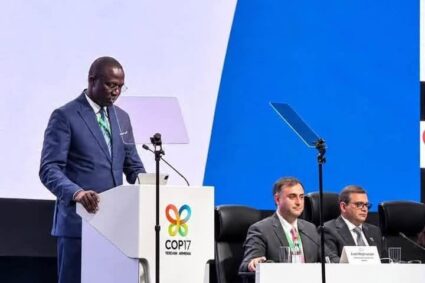

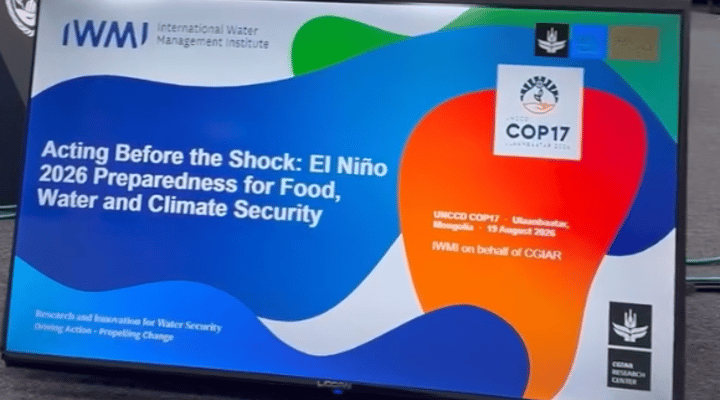
At the 17th session of the Conference of the Parties (COP17) to the United Nations Convention to Combat Desertification (UNCCD), discussions are focusing on the need to act before climate crises produce their most severe impacts.
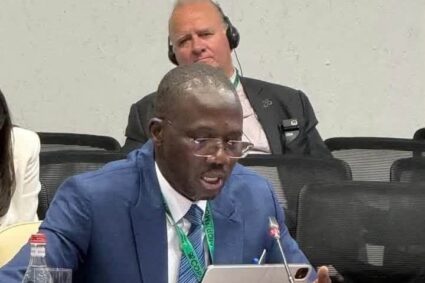
During a side event organized on 19 August 2026 by the International Water Management Institute (IWMI), participants examined ways to better prepare for El Niño, strengthen resilience to drought, and better address the interactions between water, land, climate and food security.
For farmers and rural communities, a weather forecast only has real value when it enables them to make a decision. Delaying planting, saving water, changing crop or tree species choices, strengthening irrigation, or securing livestock feed are among the measures that can help reduce losses when climate risks are anticipated.
The session was moderated by Marie-Charlotte Buisson, Head of IWMI’s Economics and Impact Assessment (EcIA) research group. It brought together, among others, Giriraj Amarnath, Head of IWMI’s Water Data for Climate Resilience research group and PrincipalFrom early warning to anticipatory action
Discussions highlighted the importance of moving from an early-warning approach to genuine preventive action. The objective is no longer simply to forecast a drought, but to enable governments, development organizations and communities to act early enough to limit losses.
In this context, IWMI presented its ENSO Outlook tool, designed to translate information on El Niño and La Niña events into practical data tailored to national contexts.
By combining climate forecasts, drought indicators and various possible preparedness measures, the tool aims to accelerate and improve decision-making.
While El Niño can influence rainfall and temperatures across large regions of the world, vulnerability remains highly dependent on local realities.
Water availability, agricultural systems, infrastructure, institutions, household incomes and access to information largely determine communities’ ability to cope with drought periods.
For the High Atlas Foundation, these challenges are particularly tangible in Morocco, where farming communities are facing increasingly irregular rainfall, water scarcity, soil degradation and a growing number of climate-related hazards.
These challenges are particularly important in tree-planting and agroforestry programmes. The first years of establishment are highly sensitive to rainfall and water availability.
Hotter or drier conditions can lead to a significant increase in seedling mortality when planting dates, irrigation, species selection or soil management are not properly adapted.
Land restoration therefore cannot be limited to planting trees. It must be based on an integrated approach that includes nurseries, technical support, sustainable water management, farmer training, plantation monitoring and continued support during the establishment and rooting perio
Another major lesson from the meeting was the need to address water, land, agriculture, energy and ecosystem issues together.
These systems are closely interconnected, particularly in rural areas.
Increased pressure on one resource can quickly affect livelihoods, agricultural production and, more broadly, the resilience of territories.
Participants also emphasized the importance of financing, incentives and equity. A large share of drought-related funding is still mobilized after damage has occurred.
One of the challenges, therefore, is to redirect more resources towards preparedness and resilience financing before a crisis occurs.
Another imperative raised during the discussions was the need to put communities at the heart of climate finance.
The issue of incentives is also crucial. Some policies may be effective at the national level while placing a disproportionate burden on smallholder farmers and rural communities with limited financial resources.
Yet these populations are often on the front line of resilience efforts: conserving trees, restoring soils, managing water resources, protecting biodiversity and adapting production systems.
For Morocco and the High Atlas Foundation, the challenge is therefore to better connect climate information with land restoration, sustainable agriculture, water management and community development.
Emerging climate and carbon financing mechanisms can also help support land restoration and agroforestry over the long term. Their effectiveness, however, will need to be assessed against the tangible benefits delivered to farmers and communities that maintain restored landscapes.
The main lesson to be drawn from the IWMI meeting at COP17 can undoubtedly be summed up in one idea: climate resilience depends on the ability to turn knowledge into timely decisions.
Tools for identifying emerging risks associated with drought and El Niño are becoming increasingly available. The challenge now is to ensure that this information reaches farmers, communities, local organizations and decision-makers in a simple, accessible and directly usable form.
But information alone is not enough. To act before the shock, local actors must also have access to the financial resources, technical capacities and incentives they need.
At COP17 of the UNCCD, the message is therefore clear: anticipate rather than repair, invest in resilience before the crisis, and place communities at the heart of land restoration and climate adaptation strategies.
Babaclimat – Journal Agropasteur